When temperatures fall and paths turn slick, many homeowners reach for salt as the quickest way to regain grip underfoot. It can be effective, but that does not automatically mean it is the best choice for every driveway, surface, or garden layout.
The right approach depends on what your driveway is made from, how often you get frost or snow, whether you have pets or children, and how much maintenance you are willing to take on. Used well, salting can reduce the risk of slips and make everyday movement far easier; used badly, it can leave behind staining, surface damage, and unnecessary cost.
Understanding where driveway salting helps, and where it may cause more problems than it solves, is essential before winter arrives. For many households, the answer is not a simple yes or no, but a balance between safety, practicality, and protecting the long-term condition of the driveway.
What driveway salting actually does
Salt works by lowering the freezing point of water, which helps break down ice and stop new ice from forming so quickly. That makes it useful when a driveway has a thin layer of frost, light ice, or compacted snow that has started to melt and refreeze.
It is important to understand that salt does not remove ice instantly. It usually needs some moisture to start working, and it performs best when used before or at the early stages of freezing conditions rather than after a thick sheet of ice has already formed.
In practice, salting is often a short-term safety measure rather than a full winter maintenance solution. It can improve traction and reduce the chance of slips, but it should be matched with sensible cleaning, drainage, and surface care.
When salting makes sense for a home driveway
There are plenty of situations where driveway salting is a sensible and cost-effective option. If your home is on a shaded plot, on a slope, or in an area that regularly sees frost, salt can make daily access much safer during cold snaps.
It is also useful if people in your household leave early in the morning, when surfaces are often at their iciest. A driveway that looks manageable in daylight can become surprisingly hazardous overnight, especially on steps, turning areas, and narrow access points.
Homeowners who need quick, low-effort winter protection often find salt appealing for another reason: it is easy to store and simple to apply. That said, the type of driveway surface matters just as much as the weather forecast.
Best-use scenarios
Salting tends to be most useful when you have one or more of the following:
- a paved, concrete, or tarmac surface that is generally well sealed
- a driveway with mild to moderate winter icing rather than deep snow build-up
- regular foot traffic where slip risk is the main concern
- limited time for more involved winter maintenance
- good drainage that prevents water from pooling and refreezing
If those conditions sound familiar, salt may be a practical part of your winter routine. If not, a different material or maintenance method may be safer in the long run.
Surfaces that need extra caution
Not every driveway responds to salt in the same way. Some materials are much more vulnerable to damage, while others can cope better if the product is used sparingly and correctly.
Brick, block paving, natural stone, and decorative finishes may all be affected by repeated salt use, particularly if the driveway already has cracks, loose joints, or signs of weathering. Salt can encourage moisture to get into weak points, and that freeze-thaw cycle can worsen surface deterioration over time.
For homeowners weighing up material choices as well as winter maintenance, it can be useful to think ahead. A property that is prone to frost damage may be better suited to one of the more durable options discussed in is a concrete driveway right for your home or is a tarmac driveway right for your home, depending on budget and appearance.
Materials that may suffer
Take particular care if your driveway includes:
- unsealed natural stone
- older mortar joints or jointing sand
- decorative brickwork with a historic finish
- recent repairs that are still settling
- surfaces with visible pitting, flaking, or cracking
In these cases, the convenience of salt may not outweigh the risk of accelerated wear. A gentler de-icing approach could be more suitable, especially if the driveway is an investment you want to preserve for years.
How salt can affect the driveway and surrounding property
One of the most common mistakes homeowners make is assuming salt only affects ice. In reality, it can influence nearby soil, planting beds, metal fixtures, and drainage areas too.
As salt washes away, it can leave a residue on the edges of the driveway or in puddling points where water collects. Over time, this may create white staining, discolouration, or a brittle feel on some surfaces, especially if salting is repeated heavily throughout winter.
It can also be harsh on garden borders, grass, and shrubs near the drive. If your driveway is lined with planting beds, wall bases, or drainage channels, careful application is essential to avoid creating avoidable damage.
Common side effects to watch for
These are the issues homeowners notice most often:
- flaking or surface wear on older paving
- grass and plant stress at the driveway edge
- rusting on metal gates, rails, or drains
- more frequent blockage in drains due to slush and grit build-up
- white residue after repeated thawing and refreezing
None of these problems means salt should never be used. They do, however, show why careful placement and moderation matter.
How to use driveway salt properly
If you decide salting is the right choice, the way you apply it makes a big difference. Many homeowners use far more than needed, which increases the chance of damage without improving safety proportionally.
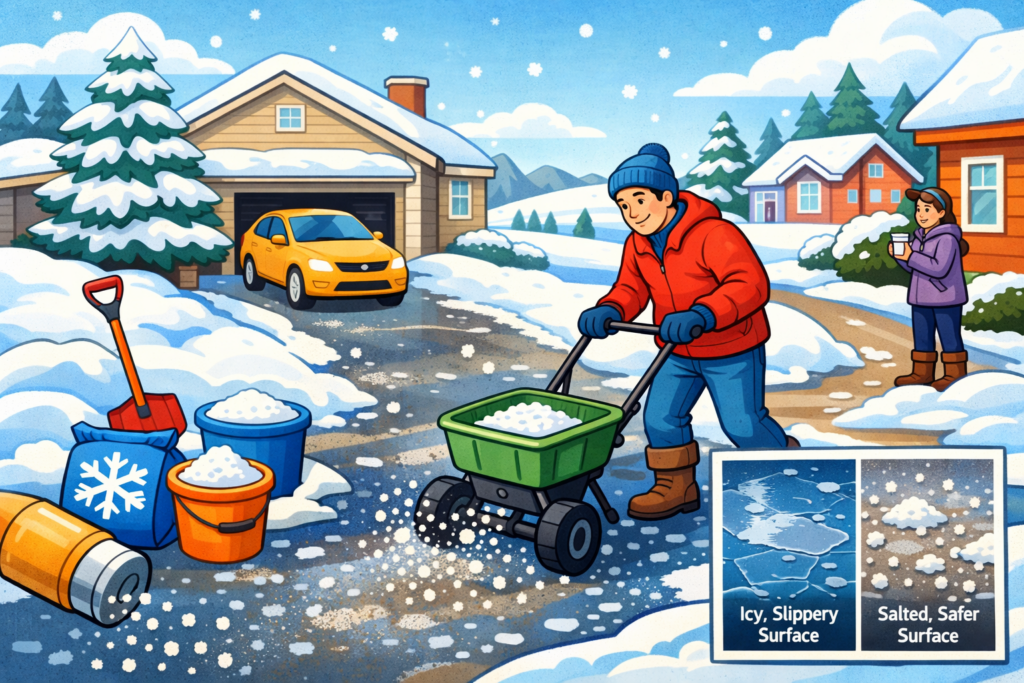
A light, even spread is usually more effective than dumping large piles in one place. You want enough product to reduce the bond between ice and the surface, not enough to leave clumps sitting around after the weather changes.
It also helps to clear away loose snow first. Salt works faster when it can reach the surface directly, and shovelling or sweeping first reduces the amount of product you need.
Practical winter habits
These simple habits can make salting safer and more efficient:
- apply before freezing conditions if possible
- use only the amount needed for the area
- clear heavy snow before spreading salt
- focus on walking routes, entrances, and slopes first
- store salt somewhere dry so it does not clump
It is also worth checking weather forecasts more closely than you might expect. A small amount of salt applied before an overnight frost is often more useful than a much larger amount added after ice has already hardened.
Alternatives to salting
Salt is not the only way to improve winter safety. Depending on your driveway and local conditions, other methods may be more suitable, either on their own or alongside reduced salting.
Some homeowners prefer grit or traction materials that improve grip without aggressively melting ice. These can be especially useful on surfaces where you want to reduce chemical exposure or protect decorative finishes.
Better drainage, prompt clearing, and surface sealing can also make a major difference. If water is not pooling on the drive, there is less chance of it freezing into dangerous patches in the first place.
For some households, the answer starts earlier than winter treatment. Choosing a surface that stands up better to seasonal weather may be a better long-term strategy, which is why guides such as is a gravel driveway right for your home and is a resin driveway right for your home can be useful when comparing low-maintenance options.
How to decide if salting suits your home
The best way to judge driveway salting is to look at the whole property, not just the forecast. A flat, sealed drive with light frost is a very different case from a sloped, decorative entrance with borders and drainage issues.
Think about how often the driveway freezes, who uses it, and what the surface is made from. If the drive is mainly used by adults who can walk carefully, the risk profile is different from a family entrance with young children, older relatives, or frequent deliveries.
You should also consider whether the driveway itself may be contributing to the problem. If standing water, cracks, or poor runoff are leading to repeated icing, salt alone is only treating the symptom. Addressing the underlying issue may save money and trouble over time.
Questions worth asking yourself
Before adding salt to your winter routine, ask whether:
- the surface can tolerate repeated de-icing
- you need melt action or just better grip
- there are nearby plants, metals, or drains to protect
- you would be better off with improved drainage or cleaning
- another driveway material might suit your climate better
If the answer to several of these points is uncertain, it may be sensible to seek professional advice before relying on salt year after year.
Common mistakes homeowners make
Many problems with driveway salting come from overuse or poor timing rather than the product itself. A common mistake is using salt on every cold morning, even when there is no visible ice and no significant risk of freezing.
Another issue is assuming that more salt means faster results. In reality, too much can increase residue, waste money, and create more run-off without meaningfully improving safety.
It is also easy to forget the surrounding area. A driveway may be treated carefully, while the front path, threshold, or steps remain untreated and hazardous.
Homeowners who are planning upgrades sometimes choose materials without considering winter care. If you are comparing installation options, it is worth looking at practical, weather-resistant choices such as the ones discussed in is driveway paving right for your home or even more specialist comparisons like is a stone driveway right for your home.
What to do before winter arrives
The most effective time to think about salting is before you need it. Once frost has set in, you may not have time to assess the surface properly or choose a better method.
Start by checking the condition of the driveway. Look for cracks, loose areas, pooled water, and signs of wear near edges and joints. If you spot problems early, you can repair them before cold weather makes them worse.
It is also sensible to keep a winter maintenance kit ready, including a shovel, a small spreader, and a suitable de-icer if your surface can handle one. That preparation makes it much easier to act quickly when temperatures drop.
What We Get Asked…
Will salt damage my driveway?
It can, especially on older, porous, decorative, or already damaged surfaces. The risk is lower on well-maintained, sealed driveways, but repeated heavy use can still leave residue and contribute to wear.
Can I use table salt instead?
Table salt is not a practical choice for driveways and is usually more expensive than purpose-made products. It is better to use a de-icer designed for external surfaces, applied sparingly and according to the conditions.
Is grit better than salt?
Grit improves traction rather than melting ice, so it can be a better option when you mainly need grip. It does not stop ice forming, but it can be kinder to sensitive materials.
How much salt should I use?
Use the minimum needed to treat the icy area evenly. A thin, consistent spread is usually more effective than piling it on, and it reduces the chance of residue and run-off.
Should I salt before or after snow?
Before freezing or early in the process is often best, as salt works more effectively when it can prevent ice bonding to the surface. After heavy snow, clear the area first so the product can do its job properly.
Our Final Thoughts
Driveway salting can be a sensible choice for many homes, but only when it is matched to the right surface and used with care. It is most helpful as a targeted winter safety measure, not a one-size-fits-all solution.
If your driveway is well sealed, regularly used, and prone to frost or light ice, salting may be a practical part of your winter routine. If the surface is fragile, decorative, or surrounded by sensitive planting, a more cautious approach may protect your property better in the long term.
Whether you are weighing up de-icing options or planning a future driveway upgrade, the key is to think about safety, maintenance, and durability together. For broader comparisons of driveway styles and materials, explore the rest of the site and choose a surface that suits both your home and your climate.